

Three Ways To Think About End-Of-Year Giving
Dear Redeemer Family,
As 2019 winds down and we prepare for Christmas celebrations, time off of work, and (hopefully) a time of rest with family - I’d like to invite all of us to consider a few different ways to think about giving before Dec. 31st.
Dear Redeemer Family,
As 2019 winds down and we prepare for Christmas celebrations, time off of work, and (hopefully) a time of rest with family - I’d like to invite all of us to consider a few different ways to think about giving before Dec. 31st.
Your First Gift: Many of you are brand new and have either: 1) Only recently decided to make Redeemer your home church, or 2) Are still somewhere in the discernment process about whether or not Redeemer will be your church home. I’d like to say to both parties - wherever you are - be all in. You may decide to stay, you may not - but either way it’s a good and healthy thing to be invested wherever you are. So I invite you to consider making your first gift.
Fulfilling Your Pledge: Those of you who are Members and have already filled out a Pledge card earlier in the year may want to double-check to see if you have fulfilled your Pledge. This is a new practice for many of us - but it is such a helpful one - both for you and for the church. Pledging helps you give strategically and intentionally. Pledging helps the church plan ahead and make wise and careful decisions. So if you are able, I invite you to fulfill your pledge.
Giving Out of Abundance: Many of us begin each year wondering if we will earn enough money to make ends meet. Some of us feel a financial pinch towards the end of the year because we had not made quite as much as we had hoped, but others of us have (remarkably!) brought in more than enough income. If the Lord has blessed you with abundance this year, I invite you to consider giving to Christ’s church out of that abundance as a way of honoring His generosity and goodness to you.
Now, many of you know that Redeemer has intentionally budgeted for a deficit this year. We have done this because, with a growing church, we wanted to staff for future growth. This means that we must grow into our budget. Additional Year-End giving is a great way you can help off-set the deficit, which will allow our little church to continue to grow and thrive in the year to come.
How do I Give? For those of you who are new to giving, please visit the GIVING PAGE on our website for instructions on how to:
Give Online
Give in the Offering Basket at Church
Mail a Check
Gift Appreciated Assets
When is the Deadline for Year-End Giving? All online gifts must be made and all checks must be dated by Dec. 31st or earlier.
Thank you dear friends. The Lord has been wonderfully generous to us this year and it’s a joy to give back to our King with grateful hearts.
In the Father’s love,
Dan
A Case For Church Membership
“Why should I become a member of a local church?”
Over the years I’ve heard a number of well-intentioned and sincere objections follow this question:
“Why should I become a member of a local church?”
Over the years I’ve heard a number of well-intentioned and sincere objections follow this question:
Membership feels exclusive, like some people are in and some are out. This isn’t very hospitable.
Membership feels too institutional, like the church is a club and not a family.
Membership means requirements and obligations, which are anti-Gospel and anti-Grace.
It might surprise you to learn this, but I used to strongly agree with each one of these objections. However, over the years, my thinking has changed significantly and - rather than membership working against hospitality, family, and Gospel - I’ve become deeply convinced that membership actually facilitates each of these!
Here’s how:
1. Membership facilitates hospitality.
Luke 14:12-14. He said also to the man who had invited him, “When you give a dinner or a banquet, do not invite your friends or your brothers or your relatives or rich neighbors, lest they also invite you in return and you be repaid. But when you give a feast, invite the poor, the crippled, the lame, the blind, and you will be blessed, because they cannot repay you.”
In Christ’s teaching, we are specifically instructed to open our doors and invite in those who are on the outside. This passage is not just about inviting in the poor vs the rich (though it is also about that), it is about extending hospitality to outsiders vs insiders. Now, if - in the name of hospitality - we say there’s no such thing as insiders or outsiders, then who will do the inviting and who will come to the party? You cannot invite others into the hospitality of God until you, yourself have received the goodness of the Lord’s hospitality. You must be in before you can invite others in.
Once you are in, you realize there are others who are out - which puts you in the perfect situation to obey Jesus’ teaching on true hospitality. In this way, Membership (a formal and clear way of defining who is in and who is out), actually sets us up to obey the Lord, open our doors, and demonstrate real hospitality to others.
2. Membership makes the church more like a family.
1 Timothy 5:1-2. “Do not rebuke an older man but encourage him as you would a father, younger men as brothers, 2 older women as mothers, younger women as sisters, in all purity.”
This passage instructs us to treat other people in the church like family. Then, our author (the Apostle Paul) goes on to give specific instructions about who to care for, how to care for them, and how to discipline people when they stray into sin. The assumption is, you can only operate as a family when it is clear who, exactly, is a part of the family. Paul is clearly not instructing us to treat all people like fathers, monthers, brothers, and sisters - but rather the people who are a part of the church family. When such individuals stray into flagrant sin, they are (temporarily, and for the sake of encouraging repentance) removed from the church family. For this kind of familial love and discipline to work, there must be some sort of clear boundary line that delineates who is in the family and who is not.
Therefore, in order for the church to function like a family, we must know who, specifically, is a part of that family. The brothers, sisters, mothers, and fathers here is not meant to signify some abstract concept of warm relationships - rather we should be thinking of specific people. i.e. my brother-in-Christ Jeromy or my father-in-Christ David. Membership helps take us from the abstract to the specific in being a church family.
3. Membership showcases the Gospel.
Ephesians 2:8-10. “For by grace you have been saved through faith. And this is not your own doing; it is the gift of God, not a result of works, so that no one may boast. For we are his workmanship, created in Christ Jesus for good works, which God prepared before hand, that we should walk in them.”
“But Membership means requirements and obligations, which are anti-Gospel and anti-Grace.” This is the one I hear most often. It is also the one to which I am, simultaneously, most sympathetic and which I disagree with the most strongly! I am sympathetic because it is absolutely true that the Gospel is the good news of the free gift of mercy and forgiveness won for us in the death and resurrection of the Lord Jesus. The Gospel is primarily about something God has done for us and not something that we do for God.
However, when we receive this free gift of mercy and forgiveness, we find that it changes absolutely everything about us. Our lives are no longer our own. We belong, body - mind - and soul - to the Lord. We begin to embody the good news of the Gospel, allowing it to shape our lives and affections.
Membership clarifies the implications of the Gospel for us and, therefore, showcases the beauty of the Gospel in the transformed lives of the members. If we resist Membership on the grounds that “the Gospel is not about doing stuff,” we are saying that the church is not have any vision for what a redeemed and renewed life in Christ should look like. A quick, cursory reading of just about any New Testament book should quickly lay that objection to rest.
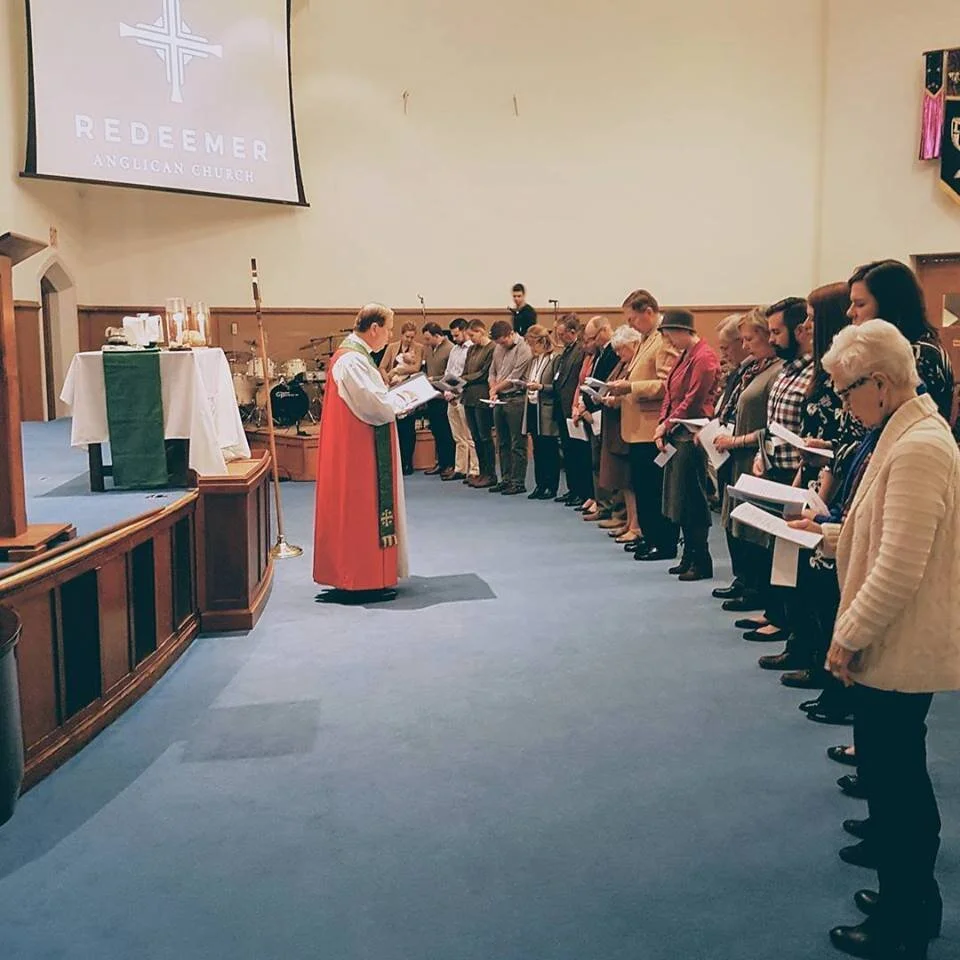
Dear friends, on February 9, 2020 - our Bishop (the Rt. Rev. John Guernsey) will visit Redeemer to confirm and welcome in new members. I want to warmly and joyfully extend the invitation to membership to absolutely all of you!
There is a simple, three-session, course to prepare you for this next step - we call it Redeemer 101 | Foundations. The goal is simply to orient you to the Gospel, the Anglican Communion, and the local vision for Redeemer.
If you have not yet taken this course, let me just say that it is a really good way to get to know our church better and discern if you’d like to become a Member.
If you have any questions about what it means to be a Member at Redeemer, or about the Membership process, please reach out to me - dan@redeemerva.org
In the Father’s love,
Dan

Celebrating Three Years of God's Faithfulness
So many wonderful things have taken place in our midst in the past twelve months. Before we turn towards the future and consider where the Lord might take us next, let’s pause and reflect on the good gifts our Heavenly Father gave to us this year:
Dear Redeemer Family,
So many wonderful things have taken place in our midst in the past twelve months. Before we turn towards the future and consider where the Lord might take us next, let’s pause and reflect on the good gifts our Heavenly Father gave to us this year:
Formalizing: Towards the end of 2018 our Diocese (the Diocese of the Mid-Atlantic) voted to receive us as a member congregation, and on January 13th 2019 I was officially installed as your Rector. (Which I count a tremendous honor and privilege).
Church Planting: On May 5th we commissioned the Rev. Steven Breedlove, along with about 40 of our own people, to plant Church of the Incarnation in Short Pump. They are off to a strong start and we
Building the Team: Our Staff has really grown this year, adding: Paul Zach - Director of Worship, Jeff King - Director of Operations, Casey Cisco - Parish Administrator, Rachel Capel - Women’s Ministry, and Ben Lansing - Small Groups Coordinator.
College Fellowships: We also brought on two, full-time college ministers, David Comeau and Tee Feyrer, who are raising their own support in order to launch Redeemer College Fellowship on campus at VCU and U. of R. respectively.
Justice & Mercy: Our work in the areas of Justice and Mercy for our City took a big step forward, with new partnerships with Youth Life Foundation, Arrabon, and Adoption & Foster Care.
Children’s Ministry: As you might have noticed, there are more than a few kids here at Redeemer! We are blessed with growing families and grateful for the work Nancy Reynolds (Dir. of Children’s Ministry) and her army of volunteers are doing to care for and disciple our youngest members.
It has indeed been a year of abundance. Thanks be to God!
As we look ahead to the coming year, we might imagine both the challenges and opportunities we will face:
CHALLENGES
Facilities: We love our location and we are deeply grateful for our partnership with Tikvat Israel. However, we have all probably felt the limits of our rented facility. Moving is difficult and should be approached cautiously. Staying would require some creative solutions - especially if we continue to grow! For the coming year, the plan is to stay put at 2715 Grove Ave. and I invite your prayers for our Vestry as we make facility decisions going forward.
Formation: With almost 100 infants, children, and teenagers that call Redeemer home, we bear (along with their parents) the enormous responsibility of their spiritual formation. As members, we take vows - whenever a child is baptized - to assist parents in raising their children. In 2020, we will all be called to fulfill those vows!
OPPORTUNITIES
Love of Neighbor: Most of our neighbors do not know the love of Christ or the hope of His resurrection. In 2020, what if that began to change? I’m not talking about some dramatic door-to-door evangelism campaign. (I’m sure we can all agree that would be more off-putting than helpful). Rather, what if unusually gracious hospitality became a means by which we reach out to our neighbors in love? From day one, we’ve said, “the front porch of Redeemer is your front porch.” I pray, in the coming year, that many of your neighbors experience the warmth of God’s love through you and your home.
Community & Belonging: So many of us are new. So rather than concluding with some rousing charge to go forth and do a bunch of stuff, I’d rather end by saying that one of the very best things we can do this year is to spend time together. The Lord has, in His kindness, gathered us into a church family. This is a good gift to be enjoyed! I pray that this is a year of deepening in community and an experience of belonging with one another.
May the Lord bless you and keep you.
In the Father’s love,
Dan

On The Odd Practice of Advent
For Christians today, the practice of observing the season of Advent can feel just as odd. In Advent we are told that we were made for life in God’s Kingdom, and that we are merely sojourners in this present world. Advent tells us that our hearts are, deep down, filled with longings which will only be satisfied in the New Creation. In this way, Advent points us forward towards the second coming (second Advent) of Christ - at which time this world will be renewed and restored.
Redeemer Family,
Imagine your great, great grandparents were born on Mars. So your great grandparents grew up hearing stories about life on Mars and what a wonderful place it was to live. They, in turn, passed on the stories to your grandparents; and they to your parents, and your parents to you. The story would go something like this:
Long ago, our family lived on Mars. Life was wonderful, the land was good, and everyone had enough to eat and drink. We were at peace. But then, things went horribly wrong. We were exiled from Mars, were sent to Earth, and have been living here in captivity ever since. One day, a rescuer is going to come and take us home, and we must live in longing, anticipation, and readiness for that day.
Can you imagine how difficult it would be to connect to that story emotionally? You’re told that you were made for another life on another world, but all you’ve ever known is this life in this world. How can you long for a land you’ve never seen? How can you anticipate something you’ve never experienced? How can you prepare yourself for something other-wordly?
For Christians today, the practice of observing the season of Advent can feel just as odd. In Advent we are told that we were made for life in God’s Kingdom, and that we are merely sojourners in this present world. Advent tells us that our hearts are, deep down, filled with longings which will only be satisfied in the New Creation. In this way, Advent points us forward towards the second coming (second Advent) of Christ - at which time this world will be renewed and restored.
(Note: The second Advent of Jesus is not about escape from this world, but rather the renewal and restoration of our world).
But how are we to engage this at any level deeper than mere intellectual assent? How can we long for a land we’ve never seen? How can we anticipate something we’ve never experienced? How can we prepare ourselves for a world unlike this world?
We need more than information, we need practices - embodied knowledge. We need traditions and liturgies and songs and readings and decorations and candles and smells and food and fasting and celebrations and much, much more. If you’ve ever wondered why churches put all this effort into Advent and Christmas, you should know that the goal is not to make a big fuss about a special occasion (although I do love a big fuss!), but rather to help us cultivate a deep knowledge, in our very bones, that a day is coming when - at long last - all will be made right.
It’s odd, I’ll give you that - about as odd as being told you’re supposed to long for Mars when all you’ve ever known is Earth. But what Christian men, women, and children have - throughout history and around the world - discovered during the season of Advent is that there is something real here. There really is a deep longing within our hearts and yearns for thing which nothing in this world can satisfy. As CS Lewis memorably wrote, “If I find in myself desires which nothing in this world can satisfy, the only logical explanation is that I was made for another world.”
Dear church family, we were - all of us - made for the New Creation. Shalom at Peace. A restored life with God, each other, ourselves, and the land.
And the odd promise of Advent is that this will, in fact, come true.
In the Father’s love,
Dan

Proverbs and Marriage
If you want to learn from proverbs, you must think yourself a usual man. If you want proverbs to have anything to do with you, you cannot think yourself atypical. You must think yourself ordinary, the kind of fellow that warning labels and parables were written for. If you want to learn from the wisdom of the ages, you have to give up thinking yourself special. If you’re special, proverbs don’t have anything to do with you.
[This is the manuscript of a talk given at the Redeemer Men’s Gathering at Canon and Draw Brewery, October 28, 2019 by Josh Gibbs—author, lecturer, and teacher of classical literature at Veritas School.]
I would like to spend my time with you explaining two proverbs— one from the poet Petrarch, the other from the Greek sage Hesiod. I will begin by reading both proverbs, but it will take me a little while to return to them.
The first proverb is from Petrarch, and it is: He who can say how much he loves, loves but little.
The second proverb is from Hesiod, and it is: At the beginning of the cask and at the end take thy fill, but be saving in the middle; for at the bottom saving comes too late.
Before speaking on these particular proverbs, I need to say something about proverbs in general.
“Honor the Lord with your wealth, then your barns will be overflowing.”
So says Solomon. However, I would wager we have all heard of a man who honored the Lord with his wealth and died poor, or that we have all heard of a man who didn’t honor the Lord with his wealth and his barns were overflowing nonetheless.
“A wise son brings joy to his father, but a foolish son brings grief to his mother.”
Again, Solomon. Although, I suppose we’ve all heard of a wise son whose father took no delight in his son, and as a teacher, I have known a few foolish sons whose mothers delighted in them anyway, and sometimes even delighted in their foolishness.
Such cases are rare, but they are not impossible, and so we must understand that proverbs are not scientific laws. Proverbs are not mathematical equations. The fact that Hugh Hefner died with fifty million dollars in the bank stands in defiance of half the things Solomon wrote.
While proverbs do not use words like “usually,” “commonly,” “often,” or “typically”, proverbs describe the world as it usually, commonly, typically is. Not all wise sons bring joy to their fathers, but most of them do. Not all girls like flowers, but most of them do. Not all men like to grill, but most of them do. The wager of a proverb is that it is better to know most women like flowers than to know some women don’t.
Of course, this is true not only of the proverbs of Solomon, but the proverbs of Kierkegaard, Nietzsche, Marcus Aurelius, Confucius, not to mention all the cultural proverbs we have inherited from the English and the French about agrarian life.
Proverbs describe the world as it is right down the middle. Proverbs describe the world as it is 98.1% of the time. It is telling that most of the proverbs in Scripture come from Solomon because the proverb is kingly wisdom. A king does not need to understand individuals so much as he needs to understand human nature. A king needs to know what will please most of the people, what will alarm most of the people. A king needs to know what people are like, which means he needs to know what husbands are like, what cops are like, what prostitutes are like. A king needs to know the nature of things and proverbs report human nature. Proverbs are based on surveys of mankind. When I refer to human nature, I mean the conditions under which men tend to thrive or tend to fall apart. Whenever we discover what usually happens to a thing under certain conditions, we have discovered something about it’s nature. And so proverbs describe what usually becomes of men who touch other men’s wives, what usually becomes of women who seduce men, what usually becomes of children who honor their parents, what usually becomes of men who drink before noon.
If you want to learn from proverbs, you must think yourself a usual man. If you want proverbs to have anything to do with you, you cannot think yourself atypical. You must think yourself ordinary, the kind of fellow that warning labels and parables were written for. If you want to learn from the wisdom of the ages, you have to give up thinking yourself special. If you’re special, proverbs don’t have anything to do with you.
As someone who has been a teacher for fifteen years, I have spoken to hundreds of parents about the souls of their teenage children, and I can say with confidence that people who think themselves special are some of the unhappiest and least productive people you will ever meet. They do not readily take advice, they are generally adverse to common sense, they do not think they will suffer by breaking the rules, and generally have very little sense of self-awareness and thus often cannot tell when they have embarrassed themselves horribly.
Of course, having set the word “special” within the context of proverbial wisdom, being special sounds very silly. However, there is a realm of human experience where men who think themselves common nonetheless have great difficulty releasing hold on the claim to be special. That is their marriages. It is one thing to say, “I am an average man,” but most men feel some shame at saying, “I have an average marriage.” Christian men especially feel shame at confessing their marriages average.
In a 2014 article for First Things entitled “The Good-Enough Marriage,” Mark Regnerus wrote:
Amid well-intentioned efforts to reinforce or rebuild a disappearing marriage culture, there remains a persistent hazard—that in belaboring the beauty of marriage very many people in challenging unions will feel more discouraged, not less. Their marriages haven’t felt wonderful for a very long time. Or the dismal follows the wonderful in a predictably cyclical fashion. Or misunderstanding seems chronic. Bedrooms become battlegrounds. It’s not how marriage was intended to be, but it is how many turn and how some remain.
When I was a very young man, the idea of someday having a “good-enough marriage” was terrifying. In fact, the very expression “good-enough marriage” was self-defeating, self-contradictory, for any marriage I might describe as “good-enough” was, by definition, not good enough. I wanted a special marriage. And I thought myself equal to the task.
The desire for a special marriage was born of the fact that by the time I got married, I’d had three serious girlfriends, the third of whom I married, and all three had been long-distance relationships. Long-distance relationships skew a fellow’s understanding of marriage because in a long-distance relationship, the relationship is always about itself. This is broadly true of all young romances, but it especially true of love-distance romances.
“How can you say you love God, whom you cannot see, when you do not love men, whom you can see?” asks St. John, thus confirming our suspicions that it is harder to love someone who is far off than someone near. Long-distance romances are constantly on the verge of dissolving into nothingness and so, in order to last, they must constantly reassert themselves, even though there is very little to reassert. Many long-distance relationships end up chiefly concerning not the love of the other, but the love of love.
The participants in a long-distance relationship cannot really do anything together, they cannot accomplish anything, they cannot produce anything, cannot labor together— even though joint labor is what most healthy marriages consist of, day in and day out. The beginning of a marriage is not like this, though. The preface to most marriages is six months to a year of planning a wedding. Engaged or nearly engaged couples think constantly of the relationship itself which is emerging— how physically intimate should they be before marrying? Is it wise to spend so much time alone given the temptations which arise? Do their friends think it a good match? Will their families get on with one another?
Speaking and thinking of the relationship prior to marriage is far easier, though, than speaking of the marriage after the fact. This is because a man is free to marry for whatever reasons he likes. A man may marry a woman because she is kind, wise, virtuous, beautiful, rich, from a good family, or because he believes she will be a good mother, supportive wife. A man rarely has any difficulty explaining why he is marrying a woman.
But every great love ultimately involves taking an oath. Husbands make oaths to wives. Christians make oaths to God and church. Soldiers make oaths to their countries. And something strange happens to love the moment it passes through an oath. A man may marry a woman because she is kind and beautiful, but he cannot stay married to her for these reasons. His reasons for marrying are, in the act of marriage, sublimated into something higher, something beyond reason, something beyond words. I married my wife because she was good and beautiful, but when my students ask me why I love my wife, I typically give one of two responses. The first, “Because I have made an oath to God that I would love her,” and the second is, “I don’t know.” The second is, to be honest, the far more truthful. It is a far more accurate assessment of the situation. She is still good and beautiful, but these are reasons I like her. These are reasons she is pleasant to live with. Were she to lose her beauty and her goodness, I would not be free to dissolve our marriage.
Oaths transcend rationality. For this very reason, the earliest Enlightenment philosophers were not fond of marriage. If it makes sense to live with someone and have children with someone, do it, and when it stops making sense, the relationship should obviously be dissolved. There is no need for some superstitious love incantation pronounced in a church before many witnesses to bind two people together eternally when they no longer love one another, no longer need one another, and would prefer the sexual company of others.
Returning to the quote from Petrarch, though, allow me to suggest, that when a relationship moves beyond reason, it has largely moved beyond words, as well. Not every arrangement of words is purely rational, of course, and so old married couples talk of the marriage itself from time to time. Nonetheless, the happiest marriages I have observed tend to be the ones wherein little time is given to the discussion of marriage. I mean the happiest husbands do not speak often of marriage theories, marriage theologies, gender roles, submission, complementarianism, or whatever Christian theology of marriage is fashionable at the moment. The same is true of childrearing, as well. Some of the worst parents I have ever known — the parents least competent to raise happy, pious children — are constantly reading books on childrearing, constantly commenting on the childrearing techniques of others, constantly describing the theories and research and books which stand behind their decision to sleep train, to spank or not spank, to give or not give an allowance.
Many older Christian men advise younger men that marriage is hard work and compromise, which is true, but we too often conceive of this hard work and compromise as being about marriage itself. Consider for a moment the staggering volume of popular, trendy Christian books on the subject of marriage. Every few years or so, some new concept is introduced by Christian book publishers as being the key to a good marriage, and a spate of books are issued which offer insights into achieving this quality. Thus, the “holy marriage,” the “biblical marriage,” the “vertical” marriage, the marriage which “restores,” the marriage which teaches you to “cherish” your partner, “respect” your partner, or instructional guides to what “radical” husbands do. Having written book proposals before, I can tell you that every fashionable book on marriage involved the author selling their unique, special take on the subject to Thomas Nelson, Zondervan or whoever.
Reading books on marriage is not part of the hard work of marriage. What is more, a great many marriage books advise readers on how to talk about their marriage, how to talk about their feelings about their spouse, how to talk about “needs” – in short, how to make the marriage itself a subject of conversation.
Ours is an age which believes— despite a staggering amount of evidence to the contrary— that sitting down and talking is a good way of sorting out our problems.
As a teacher, I can report that sitting down and talking with parents who are angry with me almost always makes things much, much worse. On average, my wife and I have two long conversations about a substantial disagreement every year. In these conversations, we talk about us, we talk about our feelings, our needs. We do not shout, we do not trot out our respective records of wrongs, and yet, on average, one of those conversations leads us to resolve our disagreement and the other makes the disagreement more pronounced and acrimonious. To be frank, we have been trained by rationalists and atheists to believe that “sitting down and talking” is the way sane humans solve their problems. While I have talked through some problems and disagreements in my life, the idea we can talk through our problems sounds lovely, but it’s just far too easy. It suggests we need not suffer much to solve our problems. There’s a lot of longsuffering which attends not presenting your case, which means not talking. Being quick to listen and slow to speak does not mean being quick to have conversation.
More than most people, writers feel and know the limitations of words. In Till We Have Faces, Lewis writes, from the perspective of Orual, his protagonist:
Lightly men talk of saying what they mean. Often when he was teaching me to write in Greek [my old teacher] would say, 'Child, to say the very thing you really mean, the whole of it, nothing more or less or other than what you really mean; that's the whole art and joy of words.'
A glib saying. When the time comes to you at which you will be forced at last to utter the speech which has lain at the center of your soul for years which you have, all that time, idiot-like, been saying over and over, you'll not talk about the joy of words.
The late Catholic short story writer Andre Dubus has a remarkable essay entitled “On Charon’s Wharf,” wherein he meditates on the silence required to take the Lord’s Supper and the wordless meals he often enjoyed with his wife. I would like to read a portion of that essay now.
Since we are all terminally ill, each breath and step and day one closer to the last, I must consider those sacraments which soothe our passage. I write on a Wednesday morning in December when snow covers the earth, the sky is grey, and only the evergreens seem alive. This morning I received the sacrament I still believe in: at seven-fifteen the priest elevated the host, then the chalice, and spoke the words of the ritual, and the bread became flesh, the wine became blood, and minutes later I placed on my tongue the taste of forgiveness and of love that affirmed, perhaps celebrated, my being alive, my being mortal. This has nothing to do with immortality, with eternity; I love the earth too much to contemplate a life apart from it, although I believe in that life. No, this has to do with mortality and the touch of flesh, and my belief in the sacrament of the Eucharist is simple: without touch, God is a monologue, an idea, a philosophy; he must touch and be touched, the tongue on flesh, and that touch is the result of the monologues, the idea, the philosophies which led to faith; but in the instant of the touch there is no place for thinking, for talking; the silent touch affirms all that and goes deeper: it affirms the mysteries of love and mortality….
So many of us fail: we divorce wives and husbands, we leave the roofs of our lovers, go once again into the lonely march, mustering our courage with work, friends, half-pleasures which are not whole because they are not shared. Yet still I believe in love’s possibility, in its presence on the earth; as I believe I can approach the altar on any morning of any day which may be the last and receive the touch that does not, for me, say: There is no death; but does say: In this instant I recognize, with you, that you must die.
And I believe I can do this in an ordinary kitchen with an ordinary woman and five eggs. I scramble them in a saucepan, as my now-dead friend taught me; they stand deeper and cook softer, he said. I take our plates, spoon eggs on them, we sit and eat. She and I in the kitchen have become extraordinary: we are not simply eating; we are pausing in the march to perform an act together; we are in love; and the meal offered and received is a sacrament which says: I know you will die; I am sharing food with you; it is all I can do, and it is everything.
As lovers we must have these sacraments, these actions which restore our focus, and therefore ourselves. For our lives are hurried and much too distracted, and one of the strangest and most dangerous of all distractions is this lethargy of self we suffer from, this part of ourselves that does not want to get out of bed and once out of bed does not want to dress and once dressed does not want to prepare breakfast and once fed does not want to work. And what does it want? Perhaps it wants nothing at all. It is a mystery, a lovely one because it is human, but it is also dangerous. Some days it does not want to love, and we yield to it, we drop into an abyss whose walls echo with strange dialogues. These dialogues are with the beloved, and at their center is a repetition of the word I and sometimes you, but neither word now is uttered with a nimbus of blessing. These are the nights when we sit in that kitchen and talk too long and too much, so that the words multiply each other, and what they express — pain, doubt, anxiousness, dread — become emotions which are not rooted in our true (or better) selves, which exist apart from those two gentle people who shared eggs at this same table which now is soiled with ashes and glass-rings.
These nights can destroy us. With words we create genies which rise on the table between us, and fearfully we watch them hurt each other; they look like us, they sound like us, but they are not us, and we want to call them back, see them disappear like shriveling clouds back into our throats, down into our hearts where they can join our other selves and be forced again into their true size: a small I among many other I‘s. We try this with more words and too often the words are the wrong ones, the genies grow, and we are approaching those hours after midnight when lovers should never quarrel, for the night has its mystery too and will not be denied, it loves to distort the way we feel and if we let it, it will. We say: But wait a minute … But you said … But I always thought that …Well how do you think I feel, who do you think you are anyway? Just who in the hell do you think you are?
I need and want to give the intimacy we achieve with words. But words are complex: at times too powerful or fragile or simply wrong; and they are affected by a tone of voice, a gesture of a hand, a light in the eyes. And words are sometimes autonomous little demons who like to form their own parade and march away, leaving us behind. Once in a good counselor’s office I realized I was not telling the truth. She was asking me questions and I was trying to answer them, and I was indeed answering them. But I left out maybe, perhaps, I wonder. … Within minutes I was telling her about emotions I had not felt. But by then I was feeling what I was telling her, and that is the explosive nitroglycerin seeping through the hearts of lovers.
So what I want and want to give, more than the intimacy of words, is shared ritual, the sacraments. I believe that, without those, all our talking, no matter how enlightened, will finally drain us, divide us into two confused and frustrated people, then destroy us as lovers. We are of the flesh, and we must turn with faith toward that truth. We need the companion on the march, the arms and lips and body against the dark of the night. It is our flesh which lives in time and will die, and it is our love which comforts the flesh. Beneath all the words we must have this daily acknowledgement from the beloved, and we must give it too or pay the lonely price of not living fully in the world: that as lovers we live on Charon’s wharf, and he’s out there somewhere in that boat of his, and today he may row in to where we sit laughing, and reach out to grasp an ankle, hers or mine.
It would be madness to try to live so intensely as lovers that every word and every gesture between us was a sacrament, a pure sign that our love exists despite and perhaps even because of our mortality. But we can do what the priest does, with his morning consecration before entering the routine of his day; what the communicant does in that instant of touch, that quick song of the flesh, before he goes to work. We can bring our human, distracted love into focus with an act that doesn’t need words, an act which dramatizes for us what we are together. The act itself can be anything: five beaten and scrambled eggs, two glasses of wine, running beside each other in rhythm with the pace and breath of the beloved. They are all parts of that loveliest of all sacraments between man and woman, that passionate harmony of flesh whose breath and dance and murmur says: We are, we are, we are …
Dubus’ marriage sounds like a common one to me. It sounds “good enough.”
Hesiod says: At the beginning of the cask and at the end take thy fill, but be sparing in the middle; for at the bottom saving comes too late.
The sparing middle Hesiod refers to is not just the common marriage but the common years of a marriage. In the beginning of the marriage, we drink deeply. The marriage itself is referred to often, considered, planned, forged. During times of great difficulty, the marriage returns to focus. When the bread winner is fired, when a child dies, we drink deeply. The great ceremonies of life always refer to beginnings and endings— this is true not only in your life and mine, but in the life of Christ Himself, for the greatest events in the Church calendar are Annunciation, Nativity, Good Friday, and Easter— all beginnings and endings. In the middle, though, we have ordinary time. Most of the liturgical year is ordinary time and so most of life and most of your life is the sparing middle.
We take our fill at the beginning and end because beginnings and endings are inherently holy and uncommon. New life comes from God and we drink deeply for new life because Heaven has opened up to earth. However, most of a marriage passes in the sparing middle and the reason the middle is sparing is because we have things to do. Drinking is about leisure, not about labor, but a common marriage accomplishes common tasks.
A common marriage is helpful, serviceable, practical, constructive, stable, which is to say not given to many great highs and many great lows, though great highs and great lows are the stuff of compelling drama, passionate music, and transcendent art. Speaking of a marriage tends to produce great highs and great lows, as Dubus notes, but speaking of a thing removes you from it.
As CS Lewis notes in his commentary on the myth of Orpheus, you cannot do a thing and reflect on doing it at the same time. You cannot see a thing and be a thing at once. You cannot see your own eyes, only their reflection.
However, your marriage does not need many, many great highs and great lows.
In the Orthodox ritual celebration of the Lord’s Supper, each communicant comes to the front of the nave, waits in line, and finally receives tinctured bread and wine from a chalice, offered to the tongue of the suppliant on the tip of a bronze spoon. No seconds are offered, neither can the suppliant eat less than the offering. Having presented himself for communion, the suppliant must eat what is given with simplicity. He needs neither more nor less bread and wine than what sits on the spoon. To live sacramentally— acknowledging the omnipresence of a holy God, from Whom all being is given, in Whom all being is sustained, to Whom all being must return— means accepting with simplicity whatever the spoon of reality offers day by day. God has established “a time” for everything which must be done (Ecclesiastes 3), which means the “time to dance” is sanctified for dancing; dancing is the Eucharist of the time to dance. Gathering stones is the Eucharist of the time to gather stones. The Eucharist is a universal experience, for in the Eucharist, the infinite and unconsumable God is consumed. In the nave, the Eucharist binds all together; departing from the nave, the Eucharist is known variously, diversely in all the moments of our lives.
Day by day, God presents us with a time to work, a time to eat, a time to sleep, a time to read our children stories before bed. The working, the eating, the sleeping, the reading… from day to day, tradition, fate, family, society, and the Church have already determined for us what we should do. If a man is willing to be common and to live a common life filled with times and seasons which God makes common to all, he will submit himself to a mysterious, transcendent reality. The infinite Word entered finite history through a finite body; as a finite creature, through finite means, the common man enters the infinite. The man who is ever looking to make himself unique, to distinguish himself from others, to discern and seize the special things of the world— such a man will always isolate himself further and further until he is bereft of companions, bereft of comforters, heroes, and lovers.
In the end, we arrive at a startling paradox: the only way for a thing to truly be special is for it to be normal. The more special we try to make a thing, the more cut off that thing is from its nature, and it’s nature is it’s only way of returning to God.
The truth of nature is that we do not have to make the world special, we merely have to let things be what they are and to love them for what they are. You don’t need to make your celebration of Christmas special. You need to celebrate Christmas, because Christmas is glorious. You don’t need to throw special birthday parties for your children.
Once you understand what education actually is, you’ll know that you don’t need a special school, you just need a school. You can’t make the Eucharist more special than it is. It’s either the Eucharist or it’s not. The desire for things to be special is usually nothing more than thinly veiled contempt for what things naturally are, which means there is something especially tragic in the father who is desperate for his son to be special. What is so wrong with a birthday party that you need a “special birthday party”? What is so wrong a honeymoon that you need your honeymoon to be a special honeymoon? What is wrong with a child that yours needs to be special? What is so wrong with marriage that yours needs to be special? Special is just fake holy.
God tends to not create holy things. He creates common things and then, through a series of predictable rituals and ceremonies and virtuous habits of being, transforms them into holy things. My plea, then, is that you think highly enough of marriage that you not seek after a special marriage. Buying flowers for your wife isn’t going to make your marriage special. It’s going to make it normal. Doing the dishes for your wife isn’t going to make you a great husband. It’s just going to make you a husband. All your striving will not produce something extraordinary, but something ordinary, and because God is God, what is ordinary is very good. Very good enough.

On Baptism
In Christian baptism, a person is united with Jesus in His death and resurrection. We call baptism a sacrament because is a physical, tangible, material ritual that is filled with a spiritual, intangible, immaterial grace. Something physical is happening - The person is either being immersed in water or having water poured over their head. Something spiritual is happening - That person is, mysteriously (in a way that we can only barely begin to comprehend), being joined together with the Lord Jesus and, therefore, becomes a part of the church - the body of Christ.
Dear Redeemer Family,
For an occasion as special as a baptism, we often want to plan ahead, invite friends, family, and godparents, and prepare a special celebration of some kind. So, in the interest of helping us all plan ahead, I thought I’d send out the dates for baptism Sundays for 2020.
January 12th: Epiphany
April 12th: Easter
May 31st: Pentecost
Nov. 1st: All Saints Day
What is Baptism?
Now, I know that many of you are relatively new to the Christian faith and new to participating in a local church - especially a local church that practices ancient traditions like Redeemer does! So let me say a word about what Christian baptism is.
Jesus answered, “Truly, truly, I say to you, unless one is born of water and the Spirit, he cannot enter the kingdom of God. - John 3:5
Go therefore and make disciples of all nations, baptizing them in the name of the Father and of the Son and of the Holy Spirit, - Matt. 28:19
Do you not know that all of us who have been baptized into Christ Jesus were baptized into his death? We were buried therefore with him by baptism into death, in order that, just as Christ was raised from the dead by the glory of the Father, we too might walk in newness of life. - Romans 6:4
Because they formerly did not obey, when God's patience waited in the days of Noah, while the ark was being prepared, in which a few, that is, eight persons, were brought safely through water. Baptism, which corresponds to this, now saves you, not as a removal of dirt from the body but as an appeal to God for a good conscience, through the resurrection of Jesus Christ, - 1 Peter 3:20-21
In Christian baptism, a person is united with Jesus in His death and resurrection. We call baptism a sacrament because is a physical, tangible, material ritual that is filled with a spiritual, intangible, immaterial grace. Something physical is happening - The person is either being immersed in water or having water poured over their head. Something spiritual is happening - That person is, mysteriously (in a way that we can only barely begin to comprehend), being joined together with the Lord Jesus and, therefore, becomes a part of the church - the body of Christ.
The Story of Baptism spans the entirety of Scripture from Genesis to Revelation.
The Old Testament prefigures baptism: In the creation of the world, in the salvation of Noah and his family from the flood, in the exodus of the Israelites through the Red Sea, and in the Israelites crossing the Jordan River out of the wilderness and into the promised land. (There are a lot more, but these are the big ones).
Christ commands us to be baptized and to baptize others.
The New Testament authors teach on the centrality of baptism in a Christian’s life.
So who should get baptized?
Any person, young or old, who wishes to put their trust wholeheartedly in Jesus for their redemption.
Any child of a baptized adult Christian who will raise that child in the faith as a part of the church.
Why do we baptize infants as well as adults?
“We start talking to our children not because they understand us, but so that they will. Baptism is God's language whereby he starts talking to his children and initiates a relationship with them. Sacraments are a word after all.” - Peter Leithart, The Baptized Body
We baptize children, not because we think that an adult profession of faith doesn’t matter (it does, and should come at Confirmation - the other side of the coin to infant baptism), but because we seek to raise Christian children within the church.
Jesus said, “Let the little children come to me and do not hinder them.” We take the Bible at its word that little children can come directly to Jesus, they do not have to grow up first.
For Further Study
I would heartily recommend Peter Leithart’s excellent little book The Baptized Body to anyone who has serious questions about Christian baptism (especially baptizing children) and would like to learn more about it.
If you are a teenager or an adult, have never received Christian baptism, and you would like to - please email me. I would be delighted to get together and talk with you about it.
If you are a parent and your child has not been baptized - same invitation! It would be a joy to baptize your little one.
In the Father’s love,
Dan

On Marking Time
Forgetting comes naturally, remembering requires intentionality. We have to make an effort, and keep making an effort in order to remember - don’t we? This is one of the reasons why we create traditions. Traditions are (usually) heart-warming and meaningful ways of remembering, of marking time, of taking us back to the most important moments in life and in history.
(an Invitation to our Annual Members Dinner - Evening of Dec. 8)
“When your children ask in time to come, ‘What do those stones mean to you?’ then you shall tell them that the waters of the Jordan were cut off before the ark of the covenant of the Lord. When it passed over the Jordan, the waters of the Jordan were cut off. So these stones shall be to the people of Israel a memorial forever.”
– Joshua 4:6-7
These words were spoken by Joshua as the people of Israel passed through the waters of the Jordan River into the promised land of Canaan. The Israelites were instructed to build a small pile of stones that would serve as a reminder of what God had done for them - the stones were a physical symbol that was to help them remember.
Forgetting comes naturally, remembering requires intentionality. We have to make an effort, and keep making an effort in order to remember - don’t we? This is one of the reasons why we create traditions. Traditions are (usually) heart-warming and meaningful ways of remembering, of marking time, of taking us back to the most important moments in life and in history.
One tradition that we started last year here at Redeemer is the tradition of celebrating our Anniversary as a church family. Redeemer Anglican Church was born on the first Sunday of Advent of 2016 and - since that time - the Lord has done so many marvelous things in our midst! Therefore, it is good and right for us mark time by pausing and remembering all that Christ has done here in us and through us.
So, if you are a member (or if you are planning to become a member) you are warmly invited to our Annual Members Dinner the evening of Dec. 8th. We will eat and drink and sing and pray and tell stories and remember together the goodness of our King. Please reserve this evening on your calendars and plan to join us.
Thank you!
In the Father’s love,
Dan
Inviting Our Children Into Sacred Space (Or, why I don’t let my kids play tag in the sanctuary)
In the tension between a sacramental world (with it’s contoured landscape of both sacred and common spaces), and an increasingly secularized world (with a flat landscape of only common spaces) - we are raising a new generation of Christian children. What a marvelously difficult and complex task! We long for our kids to experience the beauty and love of Christ for them and we worry that too many rules, and too much behavior correction will squash their enjoyment of church worship and community. Many of us parents are terrified of hearing our kids say those four dreaded words, “Church is not fun.”
“And God said, “Let there be light,” and there was light.
And God saw that the light was good.
And God separated the light from the darkness.
God called the light Day, and the darkness he called Night.
And there was evening and there was morning, the first day.”
– Genesis 1:3-5
The world has just begun and already the Lord is separating and designating. He creates light, separates it from the darkness, and designates the light for day and the darkness for night. Then he separates waters from air, and then waters from land. Each designated for a purpose and each filled with different forms of life - birds for the air, creeping things for the ground, fish for the seas.
Fast forward to the second half of the book of Exodus and you find the Lord giving the Israelites instructions for constructing the Tabernacle - a special place, separated and designated for a special purpose - the Lord’s presence with His people.
Keep moving through the Old Testament and you will read about God’s people moving into the Promised land and King Solomon building the Temple in Jerusalem.
What is going on? From the beginning of creation - God, it seems, does not treat every atomic particle in the same way. Some things and some places are special, set-aside, holy, sacred.
Follow through into the New Testament, and you will discover Jesus taking ordinary things, separating them out from the rest and designating them for special purposes. River water for baptism, loaves and fish feed a multitude, tepid water becomes wedding reception wine, mud is used to restore a blind man’s sight, ordinary bread and wine become Holy Communion.
What is going on? It’s New Creation - God (in the Jesus) is not treating every bit of creation in the same way. Some things and some places are special, set-aside, holy, sacred.
We, as members of the family of God, are one of these bits of creation that is special, set-aside, holy, sacred. Though we may not feel it much of the time, we ourselves are separated out from the rest of humanity and designated for a special purpose - to be the body of Christ proclaiming our Lord’s death and resurrection. “But you are a chosen race, a royal priesthood, a holy nation, a people for his own possession, that you may proclaim the excellencies of him who called you out of darkness into his marvelous light”. - 1 Peter 2:9
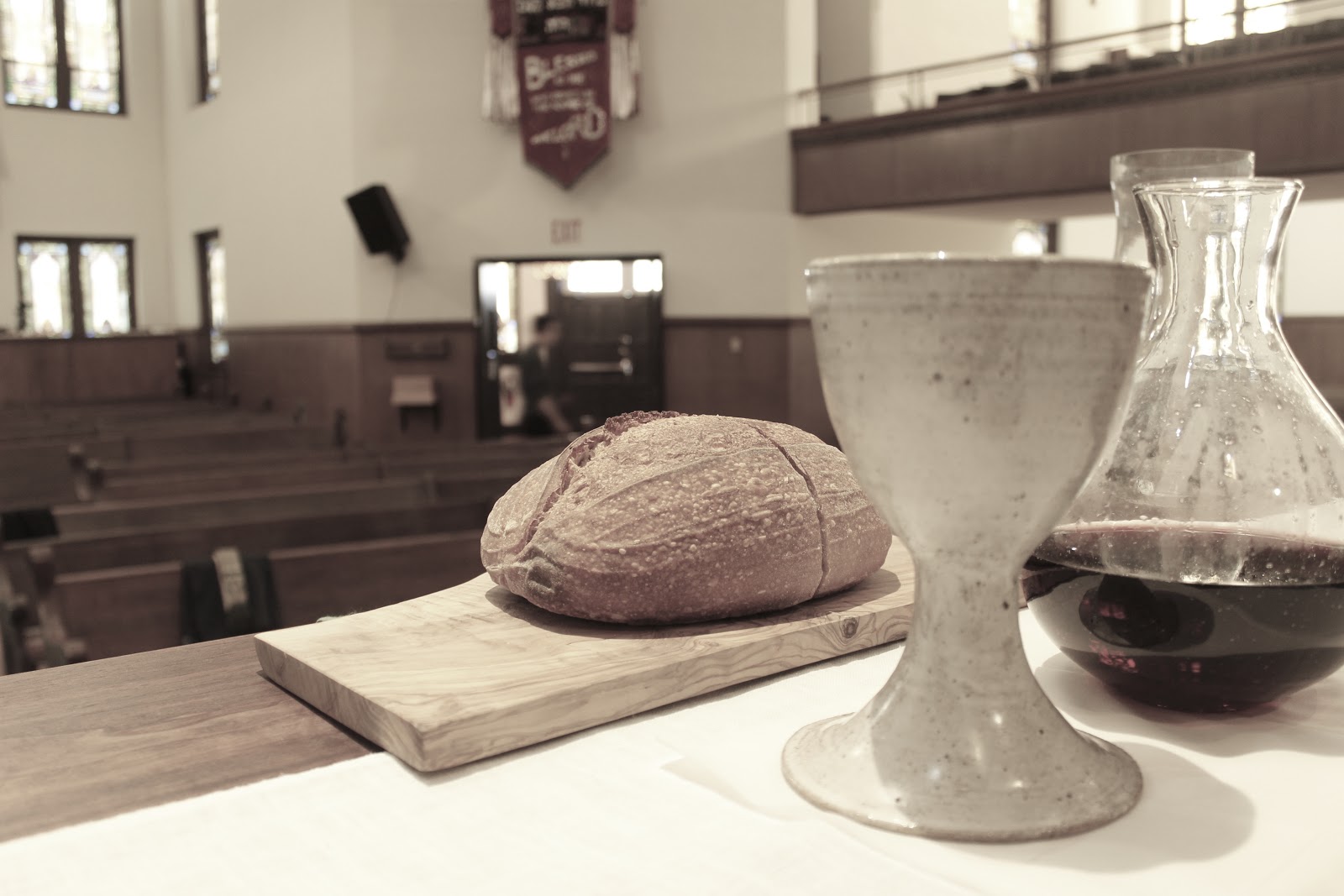
Therefore, the place where the church gathers to worship, to pray, to baptize, and to celebrate Communion becomes a sacred space. So whether the church gathers to worship in a gothic cathedral or a school cafeteria - that space becomes sacred. What makes a church sanctuary sacred is not the pews or the stained glass windows - it is the New Creation reality that the space is now different from other spaces and designated for a special purpose.
Why are we talking about this? Because we live in a rather unique moment in history where our culture seeks to flatten all spaces into generic sameness. You might imagine a house or office with an open floor plan - no separation between spaces for cooking, eating, socializing, working, or sleeping. I can now sit in my sofa with a plate of nachos, my laptop open to my email, Netflix on the TV, and a family member seated next to me. I’m eating/drinking/working/resting/socializing simultaneously!
Now, this isn’t morally wrong. Open floor plans are beautiful and, at best, lead to a wonderful sense of togetherness at home and at the office. But what is lost is specialness - a knowing of how to move and talk and act differently in different spaces.
And in the midst of this tension between a sacramental world with it’s contoured landscape of both sacred and common spaces, and an increasingly secularized world with a flat landscape of only common spaces - we are raising a new generation of Christian children! What a marvelously difficult and complex task! We long for our kids to experience the beauty and love of Christ for them and we worry that too many rules, and too much behavior correction will squash their enjoyment of church worship and community. Many of us parents are terrified of hearing our kids say those four dreaded words, “Church is not fun.”
So what are we to do? Consider this: our children are, in fact, observing us. There are few things more powerful to a young child than seeing their Mom or Dad enjoy something. In other words, adults - what you love will have a powerful shaping effect on what your children love. If you find church worship to be stuffy, boring, stiff, and fun-squashing; odds are your kids will pick up on that despite your best attempts to convince them that this is good for them. On the other hand, if your soul is truly nourished and refreshed by entering a sacred space and you begin to share that enjoyment with your children, inviting them to experience it with you; then you will open for them an entirely new way of interacting with the world that they will not find anywhere else.
Encouragement: And here’s the thing, many of you are already doing this in other places and you might not even realize it! When you say to your child, “No smart phones at the kitchen table,” or “No food in the bedroom,” you are implicitly teaching your children that not all spaces are the same. And you don’t feel badly about it for a second because you love your kids and you know that phones at the table will kill family conversation and food in the bedroom will invite the rodents.
So why do we experience that twinge of guilt when we tell our six year old that she can’t play tag in the sanctuary after the service? My guess is that most of us are just a little fuzzy in our own minds about what makes a sanctuary special. We’ve heard somewhere along the way that the Holy Spirit is present with us all the time and that we are to worship God throughout the week and not just on Sundays (both true). However, instead of allowing those truths to elevate the importance of Monday-Saturday, we’ve allowed it to devalue Sunday. Instead of allowing Christ’s presence with us to enrich the rest of life, we’ve allowed it to deplete corporate worship.
And so Sunday becomes just another day and the church sanctuary just another room.
Beloved friends, redeemed men, women, and children - Sunday is not just another day and wherever we gather for worship as the family of God is not just another room. Both are sacred because Christ is risen and is making all things new.
In the Father’s love,
Dan
Author
- 149
- Dan Marotta 16
- Casey Cisco 14
- Christian Hayes 5
- Lane Cowin 4
- Jeff King 3
- Casey Cisco 3
- Ben Lansing 3
- Mikala Thompson 3
- 2
- Claire Lewis 2
- Rachel Capel 2
- Christian Hayes 2
- 2
- 1
- Josh Gibbs 1
- Elizabeth King 1
- Mitchell Waters 1
- Paul Brasler 1
- Stephanie Workman 1
- Will Clark 1
- Cameron Bonsell 1
- 1
- Isabelle Huggard 1